Leetcode #0002: Add Two Numbers
Digit-by-digit addition (Beats ~95%)

Description
You are given two non-empty linked lists representing two non-negative integers. The digits are stored in reverse order, and each of their nodes contains a single digit. Add the two numbers and return the sum as a linked list.
You may assume the two numbers do not contain any leading zero, except the number 0 itself.
Example 1:
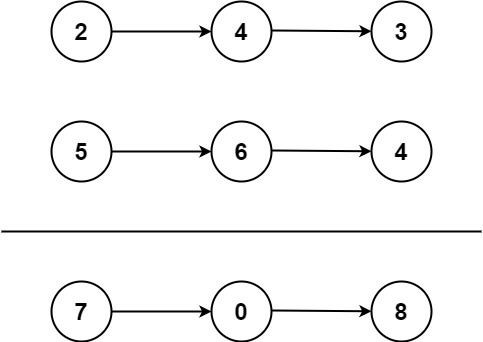
Input: l1 = [2,4,3], l2 = [5,6,4]
Output: [7,0,8]
Explanation: 342 + 465 = 807.
Example 2:
Input: l1 = [0], l2 = [0]
Output: [0]
Example 3:
Input: l1 = [9,9,9,9,9,9,9], l2 = [9,9,9,9]
Output: [8,9,9,9,0,0,0,1]
Solution
Intuition
The problem requires adding two numbers represented as linked lists, where each node contains a single digit and the digits are stored in reverse order. The key insight is to perform digit-by-digit addition while handling carry values, similar to how we perform addition by hand.
Approach
Create a dummy head node to simplify the list construction
Iterate through both lists simultaneously while there are nodes or carry value
For each position:
Sum the digits from both lists (if they exist) plus any carry
Create a new node with the ones digit (sum % 10)
Calculate the carry for the next position using integer division
The expression (sum / 10) | 0 is a JavaScript-specific optimization for integer division:
The division
sum / 10gives us a floating-point numberThe bitwise OR operator
|with 0 forces the result to be a 32-bit integerThis is faster than
Math.floor()and cleaner thanMath.trunc()
Complexity
Time complexity:
O(max(m,n))wheremandnare the lengths of the input lists- We traverse both lists once, and the length of the result is at most
max(m,n) + 1
- We traverse both lists once, and the length of the result is at most
Space complexity:
O(max(m,n))We create a new linked list to store the sum
The length of the new list is at most
max(m,n) + 1due to possible carry in the most significant digit
Code
function addTwoNumbers(first: ListNode | null, second: ListNode | null): ListNode | null {
    let carry = 0;
    const head = new ListNode();
    let current = head;

    while (first || second || carry) {
        // Calculate sum of current digits and carry:
        let sum = carry + (first?.val || 0) + (second?.val || 0);

        // Create new node with ones digit:
        current.next = new ListNode(sum % 10)

        // Calculate carry for next iteration using bitwise OR for integer division:
        carry = (sum / 10) | 0;

        // Move pointers:
        current = current.next
        first = first?.next;
        second = second?.next;
    }

    return head.next
};
The early returns aren't necessary as the main loop handles null inputs correctly, and removing them improves code readability without affecting performance.

